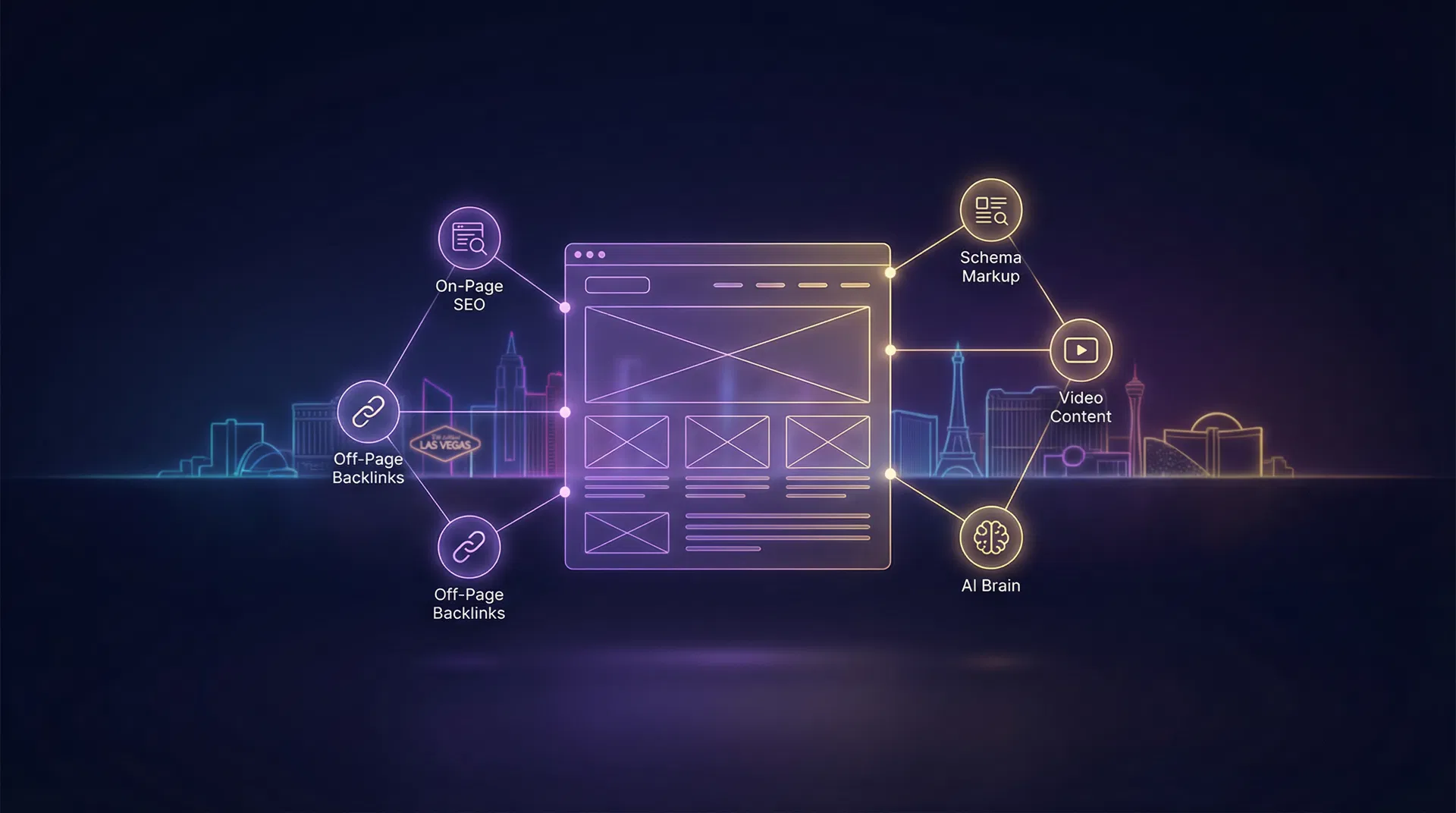
With ChatGPT, Perplexity, and Google's AI Overviews now answering questions that used to send traffic to websites, many Las Vegas business owners are asking: does SEO still matter? The short answer is yes — but the game has fundamentally shifted. Understanding why requires looking at what AI tools actually use to generate their answers.
The Myth That SEO Is Dead
Every few years, someone declares SEO dead. It happened when social media exploded. It happened when voice search arrived. And now it's happening again with generative AI. Each time, the declaration turns out to be wrong — but the way SEO works does change.
In Las Vegas, a city with over 6,000 new businesses registered every year and one of the most competitive local search landscapes in the country, the stakes are especially high. A contractor in Henderson, a med spa in Summerlin, or a wedding photographer on the Strip cannot afford to ignore how customers find them — whether that's through a Google search, a Maps query, or a prompt typed into ChatGPT.
The businesses that dismiss SEO as outdated are the same ones who will be invisible when a tourist asks their phone, "What's the best HVAC company near me in Las Vegas?" and the AI answers with three names — none of which are theirs.
What Google's Algorithm Has Always Rewarded
Google's local ranking algorithm has three core pillars: relevance, distance, and prominence. Prominence — how well-known and trusted a business is across the web — has always been the hardest to build and the most durable once established.
Citations are one of the primary signals Google uses to measure prominence. A citation is any online mention of your business's name, address, and phone number (NAP). When your NAP appears consistently across dozens or hundreds of trusted directories, review sites, and local publications, Google interprets that as a signal that your business is legitimate, established, and worth recommending.
This is not new. What is new is that the same citation data Google has been collecting for years is now being fed directly into the large language models that power AI search tools.
How AI Tools Actually Answer Local Questions
When someone asks ChatGPT, "Who are the best personal injury lawyers in Las Vegas?" the model does not browse the web in real time (unless it has a browsing plugin enabled). Instead, it draws on its training data — a massive corpus of text scraped from the internet, including business directories, review platforms, local news sites, and citation aggregators.
The businesses that appear most frequently across that corpus, with consistent and accurate information, are the ones the AI is most likely to mention. This is sometimes called GEO — Generative Engine Optimization — and it is rapidly becoming as important as traditional SEO.
Perplexity AI, which does browse the web in real time, relies heavily on structured data sources: Google Business Profile, Yelp, Bing Places, Apple Maps, and niche directories relevant to the business category. If your business is listed accurately and completely on those platforms, Perplexity is far more likely to surface you in a response.
Google's own AI Overviews — the AI-generated summaries that now appear at the top of many search results — pull from a combination of your Google Business Profile, your website's structured data markup, and the broader citation ecosystem. A business with 200 consistent citations across authoritative directories is dramatically more likely to appear in an AI Overview than one with a single GBP listing and nothing else.
The Las Vegas Advantage — and the Las Vegas Challenge
Las Vegas presents a unique SEO environment. The city attracts over 40 million visitors per year, many of whom are searching for local businesses on mobile devices, often with high purchase intent and very little brand loyalty. They are not searching for a specific plumber they've used before — they are asking Google or ChatGPT to recommend one.
That creates enormous opportunity for local businesses that have invested in their online presence. A well-optimized local business in Las Vegas can capture tourist and resident traffic that a business in a smaller market could never access.
But it also creates intense competition. Every industry in Las Vegas — from restaurants and wedding vendors to medical practices and home service contractors — is fighting for the same limited real estate in local search results and AI-generated recommendations. The businesses that win are the ones that have built the broadest, most consistent, and most authoritative citation footprints.
Why Citations Are the Foundation of Both SEO and AI Visibility
Think of citations as votes of confidence from the internet. Each time a trusted website lists your business with accurate NAP information, it is telling both Google and AI training pipelines: this business is real, it operates at this location, and it serves these customers.
The compounding effect of citations is significant. A business with listings on 25 owned-and-operated local directories, plus national platforms like Yelp, BBB, Angi, and Houzz, plus niche directories relevant to its industry, has built a web of corroborating data that is extremely difficult for competitors to replicate quickly. That data persists in AI training sets, in Google's index, and in the structured data feeds that power voice search and map applications.
Conversely, a business with inconsistent citations — different phone numbers on different platforms, an old address that was never updated, a business name that varies from listing to listing — sends conflicting signals that suppress its visibility across every channel simultaneously.
What This Means for Las Vegas Business Owners Right Now
The window to build a strong citation foundation before AI-driven search fully matures is narrowing. AI models are retrained periodically, and the businesses that are well-represented in the current data corpus will have a significant head start when those models are updated.
Here is what Las Vegas businesses should be doing today:
Audit your existing citations. Check whether your NAP is consistent across all major platforms. Inconsistencies are actively suppressing your visibility right now.
Expand your directory presence. Being listed on 5 directories is not the same as being listed on 50. Each additional authoritative listing increases your prominence score and your presence in AI training data.
Optimize your Google Business Profile. GBP remains the single most important local SEO asset. Complete every field, add photos regularly, respond to reviews, and use the posts feature to signal activity.
Build structured data into your website. Schema markup — particularly LocalBusiness, Service, and Review schemas — helps both Google and AI tools understand exactly what your business does, where it operates, and why it should be recommended.
Think about AI as a new search channel, not a replacement. The businesses that will win in the next five years are those that optimize for Google and for the AI tools that are increasingly mediating the relationship between customers and local businesses.
The Bottom Line
Las Vegas SEO is not dead. It has evolved. The businesses that built strong citation foundations over the past decade are now reaping the benefits in AI-generated recommendations they never explicitly optimized for. The businesses that are building those foundations today will be the ones that AI tools recommend tomorrow.
The question is not whether SEO still matters. The question is whether your business is visible enough — across enough trusted sources, with enough consistent data — to be the answer when a customer asks an AI what business to call.
If you are not sure, that is exactly the conversation we should be having.