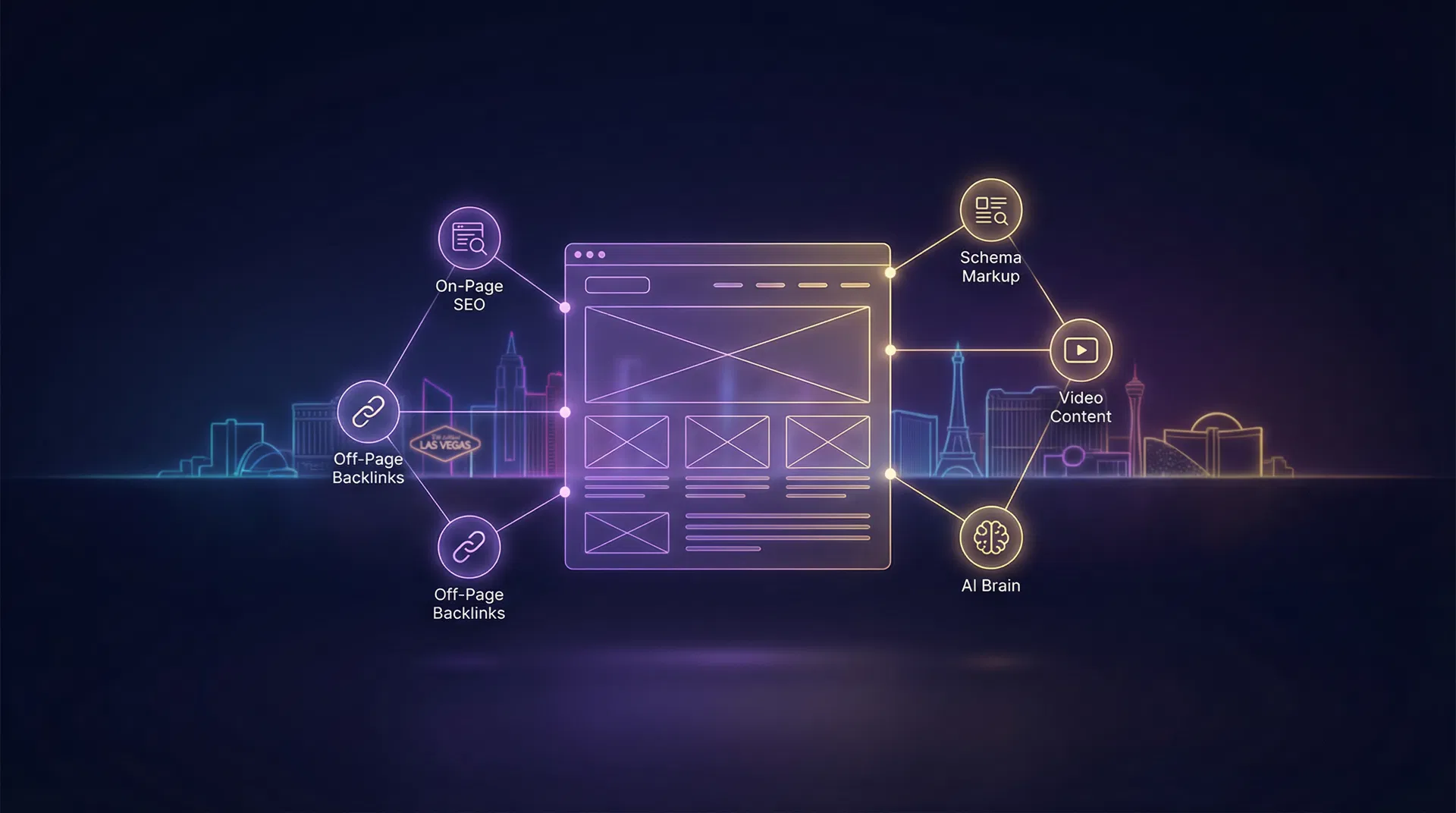
Most Las Vegas business owners think of their website as a single thing — a digital brochure that either ranks or doesn't. But in 2026, your website is a system of signals. On-page content, off-page authority, technical infrastructure, schema markup, and video content each communicate something different to search engines and AI tools. When all of these layers are aligned, the result is a business that doesn't just rank on Google — it gets recommended by ChatGPT, Perplexity, Google AI Overviews, and Apple Intelligence.
This guide breaks down every layer of website optimization, explains what each one communicates to search engines and AI models, and shows how they work together to build the kind of digital authority that gets your business recommended — not just indexed.
On-Page SEO: What Your Website Says About Itself
On-page SEO refers to everything you control directly on your website — the content, the headings, the internal links, the images, and the metadata. It is the most fundamental layer of optimization, and it is the first thing both search engines and AI tools evaluate when they crawl your site.
The goal of on-page SEO is clarity. Search engines and AI models are trying to understand exactly what your business does, who it serves, and where it operates. Every element of your page should answer those questions without ambiguity.
Title tags and meta descriptions are the first signals a search engine reads. Your title tag should include your primary keyword and your location — for example, "HVAC Repair Las Vegas | 24-Hour Service | ABC Cooling" — in under 60 characters. Your meta description should expand on that with a clear value proposition in under 160 characters. These are not just for rankings; they are the text that AI tools extract when summarizing what your page is about.
Heading structure (H1, H2, H3) acts as an outline for both crawlers and AI models. Your H1 should clearly state the primary topic of the page. Subheadings should break content into logical sections that answer specific questions your customers are asking. AI tools like ChatGPT and Google AI Overviews are trained to extract structured answers from well-organized content — a page with clear headings is far more likely to be cited than a wall of unbroken text.
Content depth and topical authority matter more in 2026 than keyword density ever did. A single page that comprehensively answers every question a customer might have about your service — what it is, how it works, what it costs, who it's for, and why your business is the right choice — signals topical authority to both Google and AI models. Thin content that exists only to target a keyword is increasingly penalized by both traditional search algorithms and AI extraction systems.
Internal linking connects your pages into a coherent knowledge structure. When your homepage links to your service pages, your service pages link to your blog posts, and your blog posts link back to your service pages, you create a web of relevance that tells search engines — and AI tools — that your site is a comprehensive resource on your topic, not a collection of isolated pages.
Image optimization — including descriptive file names, alt text, and compressed file sizes — contributes to both accessibility and crawlability. AI models that process multimodal content (text and images together) are increasingly using alt text and surrounding context to understand what an image depicts and how it relates to the page's topic.
Off-Page SEO: What the Rest of the Web Says About You
Off-page SEO refers to signals that exist outside your website — primarily backlinks, citations, reviews, and brand mentions. These signals answer a question that on-page SEO cannot: does the rest of the web agree that this business is credible and authoritative?
For local businesses in Las Vegas, the most important off-page signals are citations — consistent mentions of your business name, address, and phone number (NAP) across trusted directories, review platforms, and local publications. Google uses citation volume and consistency as a primary measure of local prominence. More importantly for 2026, AI models like ChatGPT were trained on a corpus of web content that includes business directories, review sites, and local news — meaning the businesses that appear most frequently and consistently across those sources are the ones the AI has "learned" to recognize and recommend.
Backlinks from authoritative sources remain one of the strongest off-page signals in traditional SEO. A link from the Las Vegas Review-Journal, the Las Vegas Chamber of Commerce, or a high-authority national directory tells Google that your business has been recognized by a trusted source. These same links contribute to the web-wide corpus that AI models draw on when generating recommendations.
Reviews and reputation signals are increasingly factored into both search rankings and AI recommendations. Google's local algorithm explicitly considers review quantity, recency, and sentiment. AI tools trained on review data are more likely to recommend businesses with a strong, consistent pattern of positive reviews across multiple platforms — Google, Yelp, Facebook, and industry-specific sites.
Brand mentions without links — sometimes called unlinked citations — are also meaningful. When a local blog, news site, or social media account mentions your business name in the context of your service category and location, that mention contributes to the entity recognition that AI models use to associate your brand with your industry and geography.
At VegasCitations, our core service is building this off-page foundation. We place your business across our 26+ owned-and-operated Las Vegas directories and submit to 500+ high-authority news websites, national directories, and social media platforms — creating the citation volume, NAP consistency, and brand mention frequency that both Google and AI tools are designed to reward.
Technical SEO: The Infrastructure That Makes Everything Else Work
Technical SEO refers to the behind-the-scenes infrastructure of your website — the elements that determine whether search engines and AI crawlers can access, understand, and index your content efficiently. Even the best on-page content and the strongest off-page authority will underperform if your technical foundation is broken.
Site speed and Core Web Vitals are Google's primary technical ranking signals. Core Web Vitals measure three things: Largest Contentful Paint (how quickly the main content loads), Interaction to Next Paint (how quickly the page responds to user input), and Cumulative Layout Shift (how stable the page layout is as it loads). A slow, unstable site not only ranks lower — it signals to AI crawlers that the site may not be a reliable source worth citing.
Mobile-first indexing means Google primarily evaluates the mobile version of your site, not the desktop version. In Las Vegas, where a significant share of local searches happen on smartphones — tourists searching from the Strip, residents searching from their cars — a site that performs poorly on mobile is effectively invisible to a large portion of your potential customers.
HTTPS and site security are baseline requirements. Google has used HTTPS as a ranking signal since 2014, and AI crawlers are increasingly cautious about citing content from unsecured sources. An SSL certificate is non-negotiable for any business that wants to be taken seriously by search engines or AI tools.
Crawlability and indexability determine whether search engines and AI crawlers can actually access your pages. A well-structured robots.txt file, a clean XML sitemap submitted to Google Search Console, and a logical URL structure all contribute to efficient crawling. Pages that are accidentally blocked from crawlers — a surprisingly common technical error — cannot be indexed or cited, regardless of how good their content is.
Structured URL architecture helps both users and crawlers understand the hierarchy of your site. A URL like vegascitations.com/services/local-citations communicates more about the page's content than vegascitations.com/page?id=47. Clean, descriptive URLs are a small but meaningful signal that contributes to the overall clarity of your site's structure.
Schema Markup: Speaking the Language of AI
Schema markup is structured data — code added to your website that explicitly tells search engines and AI tools what your content means, not just what it says. It is the closest thing to a direct conversation between your website and the algorithms that decide whether to recommend you.
Google confirmed in April 2025 that structured data gives websites an advantage in AI search results. Microsoft confirmed in March 2025 that schema markup helps its LLMs understand content for Bing Copilot. For Las Vegas businesses, this means schema is no longer optional — it is infrastructure.
The most important schema types for local businesses are:
LocalBusiness schema explicitly identifies your business as a local entity with a physical address, phone number, hours of operation, and service area. When an AI tool encounters a page with properly implemented LocalBusiness schema, it can extract your business information with high confidence — reducing the ambiguity that causes AI models to skip a business in favor of one they understand more clearly.
Organization schema establishes your brand as a distinct entity with a stable identity — a name, a URL, a logo, and social media profiles. This is the foundation of entity recognition: the process by which AI models learn to associate your brand name with your category, your location, and your reputation.
Article and BlogPosting schema attributes your content to a specific author and publisher, declares the publication date, and identifies the main topics covered. AI tools that use web content as training data are more likely to trust and cite content that has clear authorship and publication metadata — because those signals correlate with the kind of editorial oversight that produces reliable information.
FAQPage schema marks up question-and-answer content in a format that AI tools are specifically designed to extract. When someone asks ChatGPT or Google AI Overviews a question that your FAQ answers, a page with FAQPage schema is more likely to be surfaced as the source — because the structured format makes extraction accurate and efficient.
Review and AggregateRating schema surfaces your star ratings directly in search results and provides AI tools with a structured signal of your business's reputation. A business with 4.8 stars across 200 reviews, expressed in schema, is a much clearer recommendation signal than a business whose reviews exist only as unstructured text on a third-party platform.
The most sophisticated implementation connects these schema types into an entity graph using @graph and stable @id references — turning your website from a collection of pages into a unified knowledge structure that AI tools can navigate and trust.
Video SEO: The Fastest-Growing AI Visibility Signal
In January 2026, Search Engine Land published a landmark analysis with a striking conclusion: YouTube is no longer optional for SEO in the age of AI. As search shifts to AI-driven answers, YouTube has become a primary source material for Google's AI Overviews — and brands that underinvest in video risk losing visibility to competitors who understand this shift.
The reason is structural. Video content combines visual, auditory, and contextual information in a way that gives AI systems higher confidence when selecting content as a direct answer to a user question. A video that shows a Las Vegas HVAC technician explaining how to choose the right air conditioning unit for a desert climate provides more verifiable, multi-modal evidence of expertise than a text article making the same claims.
YouTube optimization for AI visibility requires the same discipline as traditional SEO, applied to video. Your video title should include your primary keyword and location. Your description should be a full paragraph — not just a list of links — that explains what the video covers, who it's for, and what the viewer will learn. Chapters (timestamps with descriptive labels) help AI tools identify which segment of a video answers a specific question. And a full transcript — either auto-generated and edited, or manually written — makes your video's content fully accessible to text-based AI crawlers.
Video schema markup (VideoObject) tells search engines the title, description, thumbnail, upload date, and duration of your video. When implemented correctly, it makes your video eligible for rich results in Google Search and increases the likelihood that AI tools will surface it as a source in generated answers.
Embedding videos on your website creates a bidirectional signal: your website gains the authority of the video content, and the video gains the context of your website's entity identity. A Las Vegas business that embeds a YouTube video on its service page — with proper VideoObject schema — is simultaneously strengthening its on-page content, its technical SEO, and its AI visibility in a single action.
Short-form video on social platforms — Instagram Reels, TikTok, Facebook Video — contributes to the brand mention frequency and geographic entity signals that AI models use to associate your business with your location and category. These platforms are increasingly indexed by AI crawlers, and consistent video content that tags your Las Vegas location and mentions your business name adds to the web-wide corpus of evidence that you are an established, active business in your market.
How It All Ties Together: The AI Visibility Flywheel
Each of these optimization layers — on-page, off-page, technical, schema, and video — is a distinct signal. But the businesses that achieve lasting AI visibility are not the ones that optimize one layer in isolation. They are the ones that align all five layers into a coherent, mutually reinforcing system.
Here is how the flywheel works in practice for a Las Vegas business:
Your technical SEO foundation ensures that every page on your site is crawlable, fast, and secure — so that search engines and AI crawlers can access your content without friction. Your on-page content clearly communicates what you do, who you serve, and why you are credible — giving AI tools the structured, authoritative information they need to cite you confidently. Your schema markup makes that information machine-readable, turning your website into an entity graph that AI tools can navigate and trust. Your off-page citations and backlinks confirm to both Google and AI models that the rest of the web agrees with what your website claims about itself. And your video content provides multi-modal evidence of your expertise — the highest-confidence signal an AI tool can receive when deciding whether to recommend a business.
When all five layers are aligned, something powerful happens: AI tools encounter your business repeatedly, across multiple formats and sources, with consistent information and clear entity signals. That repetition and consistency is exactly what causes an AI model to "learn" your business and recommend it confidently when a relevant question is asked.
This is not a theoretical framework. It is the mechanism behind every business that appears in Google AI Overviews, gets cited by ChatGPT, or surfaces in Perplexity when someone asks for a recommendation in your category and your city.
What This Means for Las Vegas Businesses in 2026
Las Vegas is one of the most competitive local search markets in the United States. The businesses that will dominate AI-generated recommendations in the next 12 to 24 months are the ones that are building this five-layer foundation today — while most competitors are still focused exclusively on traditional SEO or, worse, ignoring digital visibility altogether.
The window of competitive advantage is real but finite. AI models form their "opinions" about which businesses are authoritative in each category based on the web content they encounter during training. The businesses that establish a strong, consistent, multi-layer presence now will be the ones the AI recommends when the next wave of consumers starts asking their devices for local recommendations instead of typing queries into a search box.
At VegasCitations.com, we help Las Vegas businesses build this foundation systematically. Our service places your business across our network of 26+ owned-and-operated Las Vegas directories and 500+ national news sites and directories — creating the citation volume, NAP consistency, and off-page authority that anchors the entire AI visibility flywheel. Combined with schema implementation, content strategy, and video optimization guidance, we give your business the best possible foundation for being found, trusted, and recommended in the age of AI search.
If you're ready to build a website optimization strategy that works for both Google and AI tools, get listed in the VegasCitations network today — or explore our packages to find the right level of coverage for your Las Vegas business.